
The 10 Most Popular Playground Equipment In Singapore
Updated: Jul 4
The short version
Ten equipment types cover almost every Singapore playground: slides, swings, climbers, spring rockers, seesaws, roundabouts, multi-play towers, musical/sensory play, rope/net structures and spinners — each with a different age band and footprint.
Age band drives the choice. Toddler zones (1.5–4) want low platforms, spring rockers and enclosed slides; junior zones (5–12) can take taller towers, rope nets and spinners. Mixing them without zoning is the most common design mistake we see.
Fall height sets your surfacing, not the other way round. Under SS 457:2017 and SS 495:2022, the free height of fall decides how much impact-attenuating surface you need — a 2.5m tower needs far more than a 0.6m rocker.
Singapore's climate quietly narrows the list: metal slides get too hot in direct sun, timber needs more upkeep in the humidity, and every piece needs proper drainage under it after a downpour.
Space is the real constraint on most local sites. Swings and roundabouts eat the most usable area once you add safety zones; compact climbers and multi-play towers give the most play value per square metre.
By the Union Landscape team · Updated 3 July 2026 · 11 min read
Ask ten people to picture a playground and you'll get ten versions of the same handful of things: a slide, some swings, something to climb, maybe a wobbly spring animal. That instinct is right. Across our Singapore installations — condo decks, town-council void spaces, preschool yards, school fields — the same core equipment types show up again and again, because they cover the play values children actually need: sliding, swinging, climbing, balancing, spinning and rocking.
This guide walks through the ten most popular playground equipment types in Singapore. For each one we cover what it is, the age band it suits, the play value it delivers, the safety and fall-height points that decide your surfacing, and roughly how much space it eats once you add the safety zone around it. We've written it for the people who actually specify and sign off these projects — MCST managing agents, town councils, preschool and school leaders, developers — as well as parents trying to understand what makes a good play area.
If you're choosing between specific products or planning a full build, our playground and outdoor equipment range shows what these types look like as real installable pieces.
The one-line version: the equipment is the easy part — what separates a good Singapore playground from a compliance headache is matching each piece to the right age band, then sizing your impact surfacing to its fall height.
Why "popular" looks different in Singapore
A piece of equipment can be popular worldwide and still be a poor fit for a local site. Three things quietly shape what works here.
Climate. Singapore is hot, humid and wet, often in the same afternoon. Uncoated metal slides and steel decks can get uncomfortably hot in direct sun, so orientation, shade and material finish matter more than they do in temperate climates. Timber looks lovely but asks for more maintenance in the humidity. And every structure needs the ground under it to drain — standing water after a downpour ruins loose-fill surfacing and shortens the life of everything above it.
Footprint. Most Singapore play areas are tight: a strip of condo podium, a reclaimed void deck, a corner of a preschool compound. The safety zone around a piece of equipment — the clear "use zone" it needs on every side — often takes more space than the equipment itself. That constraint decides more designs here than budget does.
Compliance. Public and institutional playgrounds are expected to meet SS 457:2017 (playground equipment) and SS 495:2022 (impact attenuation of playground surfacing), which align with the European EN 1176 / EN 1177 framework. Preschools answer to ECDA, schools to MOE, and town-council and HDB sites carry their own procurement expectations. None of that changes which equipment is popular — but it changes which version of it you can actually install.
A quick self-test: for any piece you're considering, can you answer three questions — what age band is it for, what's its free height of fall, and does its use zone fit with clearance to spare? If not, you're not ready to order it yet.
The 10 most popular playground equipment types
Here's the shortlist, then a section on each.
Slides
Swings
Climbers and climbing structures
Spring rockers
Seesaws
Roundabouts (merry-go-rounds)
Multi-play towers (combination units)
Musical and sensory play
Rope and net structures
Spinners
1. Slides
What it is: the single most recognisable piece in any playground — a raised platform and a sliding chute, straight, wave or spiral, in stainless steel, HDPE plastic or a moulded tube.
Age band and play value: enormous range. Low, wide, enclosed slides suit toddlers from around 1.5–3 years; taller straight and spiral slides suit 5–12. Sliding gives vestibular (balance and motion) stimulation and a rush of success that keeps children coming back.
Safety and fall height: the fall height is governed by the platform, not the slide itself, so a tall slide platform needs correspondingly deep impact surfacing at the top. In our climate, stainless-steel slides in direct sun can get hot — orient them away from the harshest afternoon exposure, add shade, or specify HDPE where sun is unavoidable. Sides and run-out length must suit the age band.
Space: modest as a standalone chute, but the ladder or steps and the run-out at the bottom both need clear use zones. Spiral slides save footprint by winding the descent into a smaller plan area — useful on tight sites.
2. Swings
What it is: a suspended seat on a frame — flat "belt" seats for older children, enclosed cradle seats for toddlers, and increasingly inclusive nest/basket swings that several children (or a child with a carer) can use together.
Age band and play value: cradle seats from around 1 year with supervision; flat seats for confident 4-year-olds and up. Swinging is one of the strongest vestibular and calming play values — many children with sensory needs seek it out, which is why nest swings feature in inclusive designs.
Safety and fall height: swings demand the largest use zones of almost any popular equipment, because the safety area extends well in front of and behind the arc of travel — not just under the seat. This is the single biggest reason swings get cut from small Singapore sites. Fall height is measured from the seat at rest.
Space: the most space-hungry item on this list once the swing zone is drawn correctly. On tight footprints, a single well-placed nest swing often delivers more shared play value per square metre than a two-bay flat-seat set.
3. Climbers and climbing structures
What it is: a broad family — arch climbers, boulders, climbing walls, geometric dome frames and clamber stacks — anything that gets children moving up, over and through.
Age band and play value: scalable by height and hold spacing, so there are toddler-height versions and challenging 8–12 versions. Climbing builds upper-body strength, coordination and risk judgement, and it packs a lot of physical play into a small plan area.
Safety and fall height: climbing is where free height of fall matters most, because children are deliberately going high. The higher the climbing element, the deeper and more capable your impact surfacing has to be beneath and around it. Hold and rung spacing should match the target age.
Space: excellent value — many climbers deliver strong play value in a compact footprint, which is exactly why they suit Singapore's tight sites.
4. Spring rockers
What it is: a moulded seat — often an animal, vehicle or abstract shape — mounted on a heavy-duty spring so a child can rock back and forth.
Age band and play value: the classic toddler and young-child piece, roughly 1.5–5 years. It delivers rocking motion and imaginative play at ground level with very low risk, which is why almost every preschool and toddler zone has one.
Safety and fall height: low free height of fall, so surfacing requirements are gentle compared with towers and climbers — but you still need impact surfacing, and the spring mechanism should be guarded so small fingers can't be pinched.
Space: small. Rockers are a natural way to fill out a toddler zone without eating the footprint you need for larger pieces.
5. Seesaws
What it is: the traditional pivoting plank for two, plus modern spring-cushioned and multi-seat versions that soften the old hard "bump" at the bottom.
Age band and play value: best for around 4–10, and one of the few pieces that requires cooperation — two children have to work together to make it move, which is social play value you don't get from a slide.
Safety and fall height: the classic seesaw risk is the sudden drop when one rider dismounts. Modern spring-damped designs reduce this, and are worth specifying for younger users. Fall height is low, but the pinch point under each seat needs a guard or a buffer.
Space: the see-saw needs a clear zone along its full length of travel at both ends. Moderate footprint — larger than a rocker, smaller than a swing set.
6. Roundabouts (merry-go-rounds)
What it is: a rotating platform children ride or spin — from classic sit-on carousels to modern flush, ground-level inclusive roundabouts a wheelchair can roll onto.
Age band and play value: broad, roughly 3–12, with a strong pull for children who seek spinning and speed. The inclusive flush versions are a genuine step forward for mixed-ability play areas.
Safety and fall height: rotating equipment carries its own hazards — being thrown off, or a limb catching underneath. Modern designs manage speed and close the gap between the platform and the ground. The use zone must account for the full swept circle plus a clear margin.
Space: the circular use zone makes roundabouts one of the more space-hungry pieces, second only to swings on most sites. Worth it where spinning play is a priority; often the first cut where space is scarce.
7. Multi-play towers (combination units)
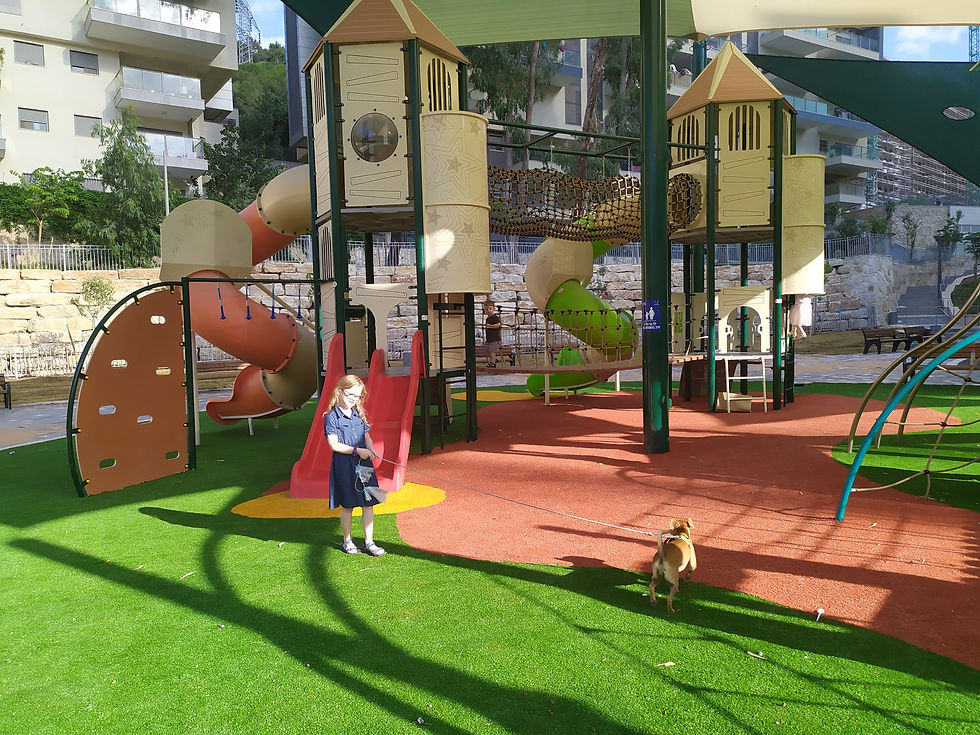
What it is: the big centrepiece — linked platforms, slides, climbers, bridges and panels combined into one structure. This is what most people picture as "a playground."
Age band and play value: usually zoned within the unit itself — lower, enclosed sections for younger children, higher decks and harder climbs for older ones. It's the most play value per structure, and the best anchor for a larger site.
Safety and fall height: the highest decks set your worst-case fall height, so the tower dictates the deepest surfacing spec on the whole playground. Guardrails, barriers and infill on elevated platforms must match the age band and the deck height.
Space: the largest single footprint, but also the most efficient in play-value-per-square-metre terms because it stacks functions vertically. On many Singapore sites, one well-chosen combination unit plus a swing or two is the whole playground.
8. Musical and sensory play
What it is: outdoor chimes, drums, xylophones and tactile panels — plus textured, interactive and cause-and-effect elements that engage senses rather than gross-motor movement.
Age band and play value: wide-open, from toddlers to older children, and especially valuable in inclusive and preschool settings. It gives quieter, non-physical play value — creativity, sound, turn-taking — that balances out the running-and-climbing pieces.
Safety and fall height: almost all of it is ground-level, so free height of fall is minimal and surfacing demands are light. The main considerations are durable, weatherproof materials that survive the Singapore sun and rain, and fixings that stay secure with heavy use.
Space: flexible and low-demand. Musical and sensory elements are an easy way to add value along a path edge or in a pocket of space too small for a large structure.
9. Rope and net structures
What it is: climbing nets, rope pyramids, cable bridges and spatial net structures — flexible, three-dimensional climbing that moves as children move on it.
Age band and play value: generally 5–12 and up; the shifting surface demands balance, planning and nerve, which makes it a favourite for older children who've outgrown the toddler pieces. Great for keeping a wide age range interested on one site.
Safety and fall height: these go high and the fall height can be significant, so surfacing beneath them must be specified to the worst case. Net and rope quality, tensioning and connectors matter enormously for both safety and lifespan — this is not a place to economise on components.
Space: a tall pyramid delivers a lot of climbing in a compact plan area, but check the use zone allows for falls in every direction, not just downward.
10. Spinners
What it is: the newer generation of single-user spinning play — standing spinners, spinning seats, dish and bowl spinners a child sits in and rotates.
Age band and play value: roughly 4–12, and hugely popular right now. Spinners deliver intense vestibular play in a small footprint, which is why they've become a go-to for adding excitement to a compact site.
Safety and fall height: the risk is the spinning motion itself — dizziness and being thrown off — so speed-managed designs and a clear surrounding zone are essential. Fall heights are usually moderate; check each product's stated figure.
Space: compact for the play value, but the use zone must account for a child losing their grip mid-spin. A strong choice when you want a "thrill" element and don't have room for a roundabout.
Planning a project?
If you're weighing up which of these belongs on your site, we're happy to walk the space with you and map equipment to your age profile, footprint and budget. Email sales@ulssg.com, call +65 6748 8719, or send the details through our contact form for a site-specific quote.
Which equipment for which age band — and what surfacing it drives
The table below maps each equipment type to a typical age band and the fall-height/surfacing consideration that follows from it. Treat the ages as guidance, not rules — manufacturers state a specific age range and a specific free height of fall for each product, and those stated figures are what your compliance and surfacing spec must follow.
Equipment type | Typical age band | Fall height / surfacing consideration |
|---|---|---|
Slides | 1.5–12 (version-dependent) | Platform height sets fall height; deeper surfacing at the top of tall slides |
Swings | 1–12 | Low fall height, but the largest use zone — surfacing must extend across the full arc |
Climbers | 2–12 (scalable) | Higher elements = deeper, more capable impact surfacing |
Spring rockers | 1.5–5 | Low fall height; gentle surfacing, guard the spring |
Seesaws | 4–10 | Low fall height; buffer the pinch point under each seat |
Roundabouts | 3–12 | Manage the swept-circle use zone; close the platform-to-ground gap |
Multi-play towers | Zoned within the unit | Highest deck sets the worst-case fall height for the whole playground |
Musical / sensory | Toddler–12 | Ground level; minimal fall height, weatherproof materials matter most |
Rope / net structures | 5–12+ | Can go high; spec surfacing to the worst-case fall in every direction |
Spinners | 4–12 | Moderate fall height; clear use zone for loss-of-grip mid-spin |
The pattern is consistent: the free height of fall decides your surfacing, not the reverse. A 2.5-metre tower deck needs far more impact-attenuating surface than a 0.6-metre spring rocker — and getting that mapping wrong is one of the most expensive mistakes to fix after installation. If you want the detail on which surface suits which situation, our guide to EPDM vs poured-in-place rubber vs rubber tiles breaks down the trade-offs for Singapore conditions.
Worth flagging: don't mix a toddler zone and a junior zone into one undivided space. Younger children wander under swings and into the swept circle of roundabouts meant for older, faster kids. Zoning — by layout, low planting or a change in surface — is one of the cheapest safety improvements you can design in from the start.
How to actually choose — a few real scenarios
Equipment lists don't decide anything on their own. Here's how the choice tends to play out on real Singapore sites.
You run a preschool (ECDA) with a small yard. Lead with spring rockers, a low enclosed slide, a toddler-height climber and a musical/sensory panel. Skip swings and roundabouts — their use zones will swallow your space. Prioritise shade and drainage.
You manage a condo with a mixed-age community. A combination multi-play tower anchors it; add one nest swing for inclusive and shared play, and a spinner for the older kids. Zone the toddler pieces separately.
You're a town council or HDB site with room to spread out. You can afford the space-hungry favourites — a swing bay, a roundabout, a rope pyramid — alongside a larger tower. This is where the full range earns its keep.
You're a school (MOE) wanting older-child challenge. Rope and net structures, taller climbers and spinners keep 8–12s engaged; make sure the surfacing under the tall pieces is specified to the worst-case fall.
You want maximum play value on a tight footprint. Compact climbers and a single well-chosen combination unit beat a scatter of small pieces every time.
Once you've settled on the mix, the harder question is who installs and certifies it. That's where a lot of projects come unstuck — our guide on how to choose a playground contractor in Singapore covers the certifications to demand and the resellers to watch out for.
Not sure where to start?
Tell us the site, the age profile and roughly the space you have, and we'll come back with a sensible equipment mix and a surfacing spec that meets SS 457 and SS 495 — not a generic brochure. Reach us at sales@ulssg.com or +65 6748 8719, or use the enquiry form.
The points people forget
A quick honest list of what tends to get overlooked once the exciting part — picking equipment — is done.
Surfacing is not an afterthought. It's a safety component in its own right, sized to your tallest fall height, and it's regulated under SS 495:2022. Budget for it properly from day one.
Use zones win or lose your layout. The clear space around each piece decides how much equipment actually fits. Draw the zones before you fall in love with a product.
Materials have to survive the weather. Sun, humidity and heavy rain are relentless here. Finish, orientation, shade and drainage decide whether a playground still looks good in three years.
Inclusion is now expected, not optional. Nest swings, flush roundabouts and ground-level sensory play let more children use the space — and increasingly they're what institutional buyers ask for.
Maintenance and inspection are part of ownership. Popular equipment stays safe only if it's inspected and maintained on a schedule. Design for access, not just for opening day.
The bottom line: the ten types here will cover almost any Singapore playground you need to build. The skill isn't in knowing them — it's in matching them to the right ages, drawing the use zones honestly, and sizing the surfacing to the tallest fall height on site.
If you'd like a second pair of eyes on a plan, a product shortlist, or a surfacing spec, the Union Landscape team is happy to help. Browse the full equipment range, email sales@ulssg.com, call +65 6748 8719, or send your site details through the contact form for a quote built around your space.
Frequently Asked Questions
What is the most popular playground equipment in Singapore?
Slides, swings and climbing structures are the most consistently popular across Singapore sites, because they cover the core play values children need — sliding, swinging and climbing — and scale across age bands. Spring rockers dominate toddler and preschool zones, while multi-play combination towers are the usual centrepiece on larger condo, HDB and school sites. Which mix is right for you depends more on your age profile and footprint than on popularity alone.
How do I know what age a piece of playground equipment is for?
Every compliant product states a specific age range and a specific free height of fall from the manufacturer. As a rough guide, spring rockers and low enclosed slides suit roughly 1.5–5 years; swings, seesaws and roundabouts suit around 4–10; and rope/net structures, taller climbers and spinners suit 5–12 and up. Always design to the manufacturer's stated figures rather than a general age band, and zone toddler and junior equipment separately so younger children don't wander into faster play areas.
How does fall height affect what surfacing I need?
Fall height is the main factor that sets your surfacing. Under SS 457:2017 and SS 495:2022, the free height of fall of a piece of equipment determines how much impact-attenuating surface you need beneath and around it. A tall multi-play tower or rope pyramid needs far deeper, more capable surfacing than a low spring rocker. The surfacing must be specified to the worst-case fall height on the site, which is usually the highest deck of your tallest structure.
Which playground equipment needs the most space?
Swings and roundabouts are the most space-hungry, because their safety use zones extend well beyond the equipment itself — the full arc of a swing or the swept circle of a roundabout, plus a clear margin. On tight Singapore sites these are often the first pieces cut. Compact climbers, spinners and a single combination tower deliver the most play value per square metre, which is why they suit small condo podiums and preschool yards.
Does Singapore's climate affect which equipment I should choose?
Yes. Uncoated metal slides and steel decks can get hot in direct afternoon sun, so orientation, shade and material finish matter — HDPE and well-shaded layouts help. Humidity means timber needs more upkeep, and heavy rain means every structure needs proper drainage underneath to protect both the surfacing and the equipment. These climate factors quietly narrow which version of a popular piece will actually last well on your site.
How do I get a quote for playground equipment in Singapore?
Pricing depends entirely on scope — the equipment mix, the surfacing spec required by your fall heights, site preparation, drainage and access. Rather than quote a figure that won't fit your site, we prefer to assess the space first. Email sales@ulssg.com, call +65 6748 8719, or send your site details through the contact form at ulssg.com/contact-page and we'll come back with a site-specific quote and a sensible equipment shortlist.


Comments