
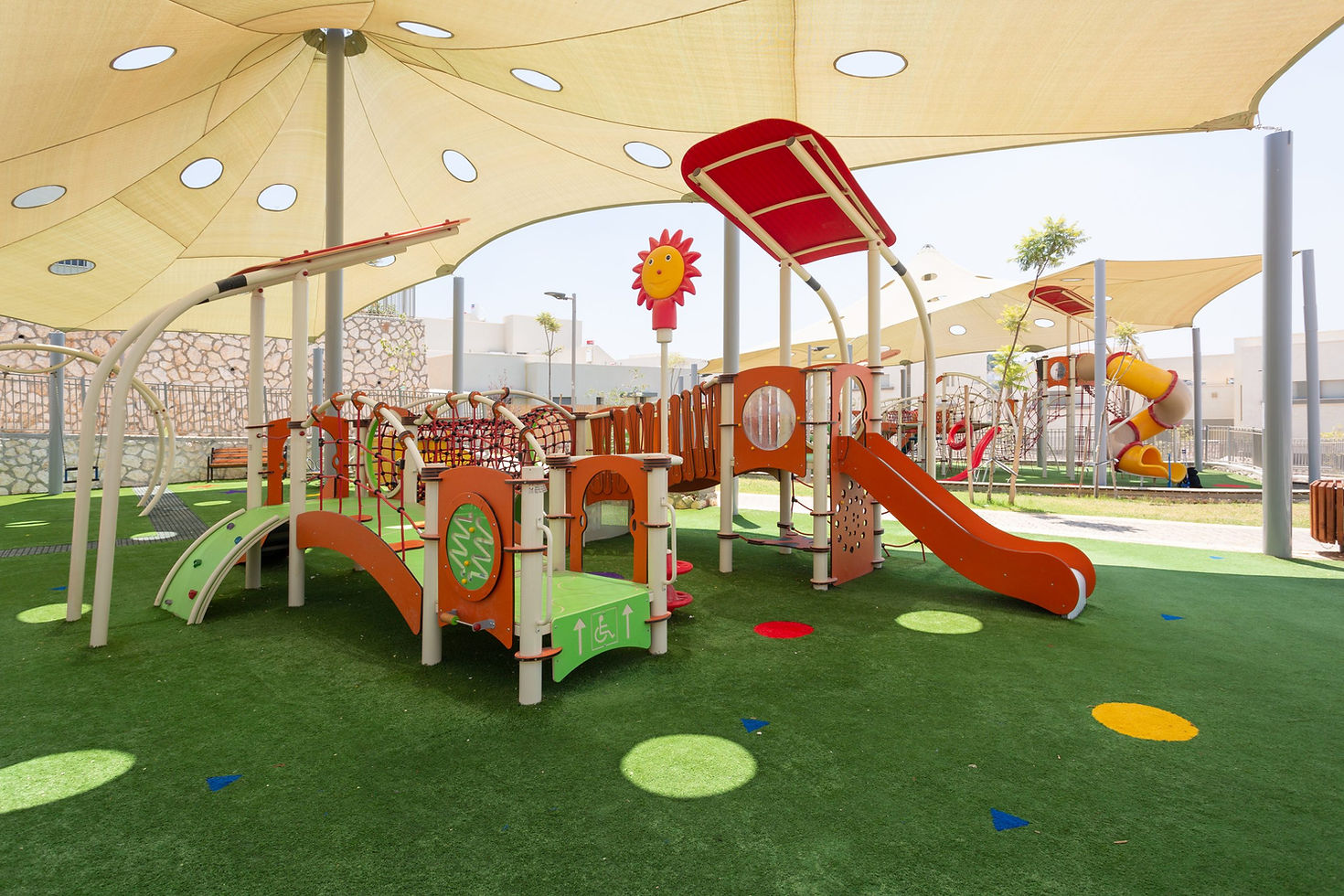
Preschool Outdoor Play Area Requirements in Singapore: An ECDA Compliance Guide for Childcare Operators

The short version
ECDA requires a real outdoor play area, and it does double duty. If your centre has a compliant outdoor play space, your indoor play area can also count as teaching-and-learning space — so getting the outdoor area right unlocks capacity indoors.
Size it against two numbers and take the larger. Play space should be at least 40 sqm, or 4 sqm per child (one-sixth of licensed capacity), whichever is greater. Access matters too: children shouldn't cross a road to reach it, and it shouldn't sit more than 2 flights of stairs / 10 steps away.
Equipment must be age-banded. Infant/toddler play (under ~2s and 2–3s) and early-childhood play (roughly 3–5s) have different heights, gaps and challenge levels under SS 457. Mixing them on one structure is a common licensing and safety flag.
Surfacing is where centres fail — it's fall-height math, not a finish choice. Under SS 457 / SS 495, your surfacing's critical fall height rating must equal or exceed the free height of fall of every piece of equipment above it. A 1.5 m platform needs surfacing tested to at least 1.5 m.
You can build around an operating centre. Age-band phasing, weekend pours and fast-cure systems let you re-do a play deck without shutting the whole centre — if it's sequenced properly from the start.
By the Union Landscape team · Reviewed by the Union Landscape technical team · Published 3 July 2026 · 11 min read
If you run or are setting up a childcare centre in Singapore, the outdoor play area is one of the few parts of your fit-out that is simultaneously a licensing requirement, a safety-standards obligation, and a daily-programme necessity — and the guidance for it is scattered across an ECDA setup guide, a Code of Practice, an ask.gov.sg FAQ, and two Singapore Standards documents you have to buy separately.
This guide pulls that together into one operator-facing checklist. We cover what ECDA expects of the space itself, how to choose equipment that matches your age bands, and the part that quietly fails the most inspections: matching your surfacing's rated critical fall height to the equipment above it. Then we get practical about building it — including how to phase works around a centre that's still open.
The one-line version: ECDA governs whether you have a compliant outdoor play area and how it's used; SS 457 and SS 495 govern whether the equipment and the surface under it are safe. You need to satisfy both, and the surfacing is where the two meet.
A note on the figures below: space, access and programme numbers reflect ECDA's published centre-setup guidance and Code of Practice at the time of writing. ECDA requirements are periodically updated — always confirm current figures against ECDA's latest Code of Practice and setup guide before finalising a design or lease.
Does ECDA actually require an outdoor play area?
In practice, yes. ECDA's centre-setup guidance expects a childcare centre to provide both an indoor and an outdoor play space, and the outdoor space isn't just a nice-to-have — it changes how your indoor floor area is counted.
Here's the mechanism operators often miss: if you have a compliant outdoor play space, your indoor play space can also be counted as teaching-and-learning space. If you don't have an outdoor play area, that indoor allocation doesn't count toward teaching-and-learning space. So a proper outdoor play area effectively unlocks usable capacity indoors. For a centre where every square metre is fighting for licensed headcount, that's a commercial decision, not just a compliance box.
The outdoor area also underwrites your daily programme obligations. Full-day programmes are expected to include around one hour of gross-motor activity per day, with at least 30 minutes of it outdoors. You cannot reliably deliver that in a space that's unusable half the week because it floods, bakes, or has no shade — which is why surfacing and layout decisions are programme decisions too.
A quick self-test — do you have an "outdoor play area" or just outdoor space? Ask three questions. (1) Can a class get there without crossing a road? (2) Can they get there without climbing more than 2 flights of stairs or 10 steps? (3) Is the surface under the equipment rated for the heights children can fall from? If any answer is "no," you have outdoor space, not yet a compliant outdoor play area.
How big does the outdoor play area need to be?
Size it against two numbers and take the larger one:
At least 40 sqm, or
4 sqm per child — i.e. roughly one-sixth of your licensed capacity.
Whichever figure is bigger is the one that governs. A 60-place centre, for example, is looking at 60 × 4 = 240 sqm of play space as the driving number, not the 40 sqm floor.
A few nuances that matter when you're laying it out:
Play space vs. teaching-and-learning space are different accounting lines. Indoor teaching-and-learning space has its own per-child minimums (more for infants than for older children). The outdoor play area is what lets your indoor play area also count on the teaching-and-learning line — so treat them as linked, not separate.
"Usable" is the operative word. Space taken up by planters, drainage, walkways, or a piece of equipment's safety zone that overlaps a wall isn't freely usable play area. Design the safety zones first (see below), then see how much genuine play space is left.
Split levels and rooftop decks count — provided the access rules are met.
Where the play area sits: the access rules that fail centres
ECDA guidance is specific about getting children to the play area safely:
No crossing roads. Children shouldn't have to cross a road to reach the outdoor playground.
No more than 2 flights of stairs / 10 steps. The play area shouldn't require children to climb more than about two flights of stairs, or ten steps, to reach it.
Adequate supervision on the move. For outdoor learning experiences, the staff-child ratio must be maintained, with an adult positioned both in front of and behind the group.
If you're eyeing a rooftop or a detached ground-level plot across a driveway, resolve access before you spend a dollar on equipment. A beautiful playground that children can't legally or safely reach is a redesign waiting to happen.
Don't do this at the start: Don't buy or specify equipment before you've fixed (a) where the play area sits and how children reach it, and (b) the free height of fall of each item and the safety zone it needs. Equipment chosen first, space fitted around it second, is the single most common reason a childcare play area has to be reworked.
Age-appropriate equipment: infant/toddler vs early-childhood play
This is where the equipment side of the standards lives. SS 457:2017 (Specification for playground equipment for public use) treats young children differently from older ones — heights, gap sizes, guardrail requirements and challenge levels all shift with the age band. A childcare centre typically has to serve more than one band on a small footprint, so age-zoning is central.
Broadly, plan around two play populations:
Infant / toddler play (roughly under 2, and 2–3 year-olds): low platforms, low or no fall heights, enclosed or well-guarded edges, gentle ramps and steps, sensory and cause-and-effect elements rather than tall climbers. Gaps and openings are sized to prevent head/limb entrapment for smaller bodies.
Early-childhood play (roughly 3–5 year-olds): more climbing, low slides, balance and coordination challenges, modest elevated platforms — but still well short of primary-school equipment heights.
Mixing these on a single structure is a frequent flag: a climber safe and appropriate for a five-year-old can present an entrapment or fall risk to a toddler, and a structure scaled for toddlers bores (and gets misused by) older children. The cleaner approach is age-zoned equipment with clear separation, each zone matched to the right surfacing depth for its heights.
The one-line version: Two age bands, two zones, two fall-height budgets. Design them separately, then knit them together — don't average them.
Union Landscape supplies a range that spans both bands — outdoor and indoor play equipment for infant/toddler through early-childhood, plus inclusive play for centres that want every child able to join in. You can see the current outdoor and indoor playground equipment range and tell us your age split; we'll spec to your bands rather than to a generic catalogue.
Planning a project?
If you're at the licensing or renewal stage and want a second pair of eyes on your outdoor play layout before you commit, [get a free site assessment](https://www.ulssg.com/contact-page) — we'll walk the space, note the access and safety-zone constraints, and tell you what will and won't pass. Prefer to talk it through first? Call us on +65 6748 8719 or email sales@ulssg.com.
The part that fails licensing: critical fall height vs. surfacing
Here is the single most important technical relationship in a childcare play area, and it's arithmetic, not aesthetics.
Every piece of equipment has a free height of fall — the greatest height from which a child could fall (typically the highest standing or sitting surface a child can get to). Every impact-attenuating surface has a critical fall height (CFH) — the height up to which, when tested, it keeps the impact below the injury threshold. These two are governed together in Singapore:
SS 457:2017 — the equipment standard, which defines free height of fall and the safety (impact) zone around equipment.
SS 495:2022 — the surfacing standard, which specifies how impact attenuation of playground surfaces is tested and rated (aligned in intent with the European EN 1177 method).
The rule to remember: the surfacing's critical fall height must be equal to or greater than the free height of fall of the equipment above it. A platform a child can fall 1.5 m from needs surfacing tested and certified to at least 1.5 m — not "rubber flooring," but rubber flooring of a build-up that achieves ≥1.5 m CFH.
Two things break this in real centres:
The surface is the right material but the wrong thickness. Rubber safety surfacing gets its CFH from its build-up, not just its top layer. Thinner build-ups rate for lower falls. Spec the height first, then the thickness — never the other way around.
The safety zone is too small. CFH covers the vertical fall; the surfacing also has to extend far enough horizontally around the equipment (the impact zone) so a child who falls sideways or off a slide still lands on rated surface, not on kerb, planter or concrete.
Rough guide: fall height to rubber surfacing build-up
Use this to sense-check a quote, not as a substitute for a tested, certified spec. Actual thickness depends on the specific system, granule and binder — always confirm the tested CFH certificate for the product you're installing before signing off any design.
Equipment free height of fall | Typical rubber safety-surfacing build-up (EPDM top + base) | Where you'll see it |
|---|---|---|
Up to ~0.6 m | Thin build-up (top wear layer over minimal base) | Infant/toddler zones, low platforms, ground-level play panels |
Up to ~1.0–1.2 m | Moderate build-up (wear layer + intermediate base course) | Toddler climbers, low slides, spring rockers |
Up to ~1.5 m | Thicker base course under the wear layer | Typical early-childhood (3–5) climbers and platforms |
~1.8 m and above | Deep build-up, or shock-pad + wear layer system | Taller early-childhood structures; verify certificate carefully |
Illustrative build-up ranges only, not a spec you can install directly. The governing number is always the manufacturer's independently tested critical fall height for that exact system (e.g. TÜV-certified test data), matched to your equipment's free height of fall under SS 457 / SS 495.
For a full breakdown of the standards themselves — what SS 457 and SS 495 each cover and how facility managers should read them — see our companion explainer, [What Are SS 457 and SS 495? Singapore's Playground Safety Standards Explained](https://www.ulssg.com/post/ss-457-ss-495-playground-safety-standards-singapore).
A quick self-test for surfacing: Point at your tallest piece of equipment. Do you know its free height of fall in metres? Do you have a tested CFH certificate for the surface under it at or above that number? Does the rated surface extend right across the impact zone, not just under the footprint? Three "yes"es and you're on solid ground.
Which surfacing should a childcare centre choose?
Once the CFH is settled, the material choice is about durability, comfort, heat, drainage and budget. The three surfaces childcare operators weigh most often:
Poured-in-place (PIP) rubber — seamless, wheelchair- and buggy-friendly, strong for inclusive play, and can be built up to high CFH. The premium option; best where you want a continuous, low-trip surface across a whole play deck.
Rubber tiles — modular, faster to install and to repair (lift and swap a damaged tile), predictable CFH per tile spec. Handy for centres that want minimal downtime or expect to reconfigure.
EPDM granule systems — the coloured wear layer used in PIP; strong for zoning and wayfinding in bright, child-friendly patterns.
You'll want poured-in-place if a seamless, inclusive, whole-deck surface matters most; rubber tiles if speed of install and easy spot-repair matter more; and you should always let the tested CFH and your equipment heights override the aesthetic preference. We compare all three in depth — cost ranges, lifespan, heat and repairability — in [EPDM vs Poured-in-Place vs Rubber Tiles: Which Playground Flooring Is Right for Your Singapore Site?](https://www.ulssg.com/post/epdm-vs-poured-in-place-vs-rubber-tiles-playground-flooring-singapore).
Two Singapore-specific realities to build in:
Heat and shade. Dark rubber gets hot in full sun. Lighter tones, shade sails or planting keep a surface usable through the day — which matters when your programme requires daily outdoor time.
Drainage. An outdoor play area that ponds after a downpour is an area that's out of use, and standing water degrades some build-ups faster. Get falls and drainage right under the surfacing, not as an afterthought.
How do you build this around an operating centre?
Most childcare outdoor upgrades don't happen on a greenfield site — they happen at a running centre during a renewal, an expansion, or after an inspection flags the surfacing. You can absolutely phase the works, but only if it's sequenced deliberately from day one.
What tends to work:
Zone-by-zone, along your age bands. Close and re-do the toddler zone while the 3–5 zone stays open, then swap. Children keep an outdoor area throughout; you keep meeting your daily outdoor-time obligation.
Weekend / after-hours pours and fast-cure systems. Where a tiled or fast-curing system fits the CFH requirement, work can be timed around operating hours to shrink or eliminate closure days.
Sequence surfacing and equipment correctly. Base prep → drainage → surfacing build-up → equipment anchoring → final wear layer and safety-zone check. Getting equipment anchored before the base is right is how projects lose days to rework.
Keep the paperwork ready. Hold your equipment (SS 457) and surfacing (SS 495) documentation and CFH certificates in one place so a licensing officer's questions are a five-minute conversation, not a scramble.
The one-line version: A phased childcare playground project isn't slower — it's just sequenced. Design the phases around your age zones and your opening hours before the first tile is lifted.
Choosing the right partner matters as much as the spec here, because build sequencing around an open centre is exactly where inexperienced contractors create downtime and compliance gaps. Our [buyer's checklist for choosing a playground contractor in Singapore](https://www.ulssg.com/post/how-to-choose-playground-contractor-singapore) walks through what to ask before you sign.
Ready to get numbers on it?
Tell us your licensed capacity, your age split, and whether you're setting up or renewing — we'll come back with an age-banded equipment plan, a CFH-matched surfacing spec, and a phasing plan that keeps your centre open. [Request a quote through our contact form](https://www.ulssg.com/contact-page), message us on WhatsApp / call +65 6748 8719, or email sales@ulssg.com.
The operator's pre-licensing checklist
Run this before an inspection or a fit-out sign-off:
Outdoor play area exists and is genuinely usable (not just leftover space).
Sized to the larger of 40 sqm or 4 sqm/child (one-sixth of capacity), with usable area confirmed after safety zones are drawn.
Access rules met: no road crossing; no more than 2 flights / 10 steps; supervision ratio holds with an adult front and back.
Equipment is age-banded (infant/toddler vs 3–5), zoned and separated, compliant with SS 457:2017.
Surfacing CFH ≥ free height of fall for every item, with a tested certificate (SS 495:2022 / EN 1177-aligned) on file.
Impact/safety zones fully surfaced — rated surface extends across the whole fall area, not just the footprint.
Heat, shade and drainage addressed so the area is usable for daily outdoor time year-round.
Documentation packaged — equipment and surfacing specs plus CFH certificates ready to show.
If you want that whole list validated on your actual site, that's exactly what a [free ULS site assessment](https://www.ulssg.com/contact-page) covers — call +65 6748 8719 and we'll arrange a visit.
Frequently Asked Questions
Does every childcare centre in Singapore need an outdoor play area to get an ECDA licence?
In practice, ECDA's centre-setup guidance expects both an indoor and an outdoor play space. The outdoor area also matters for space accounting: if you have a compliant outdoor play space, your indoor play space can additionally be counted as teaching-and-learning space; if you don't, that indoor allocation doesn't count toward teaching-and-learning space. So beyond compliance, a proper outdoor play area effectively unlocks usable indoor capacity. Always confirm the current requirement against ECDA's latest Code of Practice and setup guide for your specific licence type and capacity.
How big does a preschool outdoor play area have to be?
Size it against two figures and take the larger: at least 40 sqm, or 4 sqm per child (about one-sixth of your licensed capacity). For a 60-place centre, the 4-sqm-per-child figure (240 sqm) drives, not the 40 sqm floor. Remember that only genuinely usable area counts — space consumed by planters, walkways, drainage or an equipment safety zone that overlaps a wall doesn't. Design the safety zones first, then measure the free play space that's left.
What is 'critical fall height' and why does it fail childcare licensing?
Critical fall height (CFH) is the height up to which a tested impact-attenuating surface keeps a fall below the injury threshold. Under SS 457 (equipment) and SS 495 (surfacing), the surface's CFH must be equal to or greater than the free height of fall of the equipment above it — a 1.5 m platform needs surfacing tested to at least 1.5 m. Centres fail this two ways: the surface is the right material but too thin to achieve the needed CFH, or the rated surface doesn't extend far enough across the impact zone. Always keep a tested CFH certificate on file for the exact system installed.
What surfacing is best under preschool playground equipment?
Once CFH is satisfied, the common childcare choices are poured-in-place (PIP) rubber, rubber tiles, and EPDM granule systems. PIP is seamless and buggy/wheelchair-friendly — good for inclusive, whole-deck surfaces. Tiles install faster and let you lift-and-swap a damaged section, which minimises downtime. EPDM is the coloured wear layer used for zoning and patterns. Whatever you pick, the tested CFH must match your tallest equipment's free height of fall, and in Singapore you should also plan for heat (lighter tones/shade) and drainage.
Do infant/toddler and older preschool children need separate playground equipment?
Yes — age-band your equipment. SS 457:2017 treats young children differently on heights, gaps, guarding and challenge level. Plan for two populations: infant/toddler (low platforms, low or no fall heights, enclosed edges, sensory play) and early-childhood 3–5 (climbing, low slides, balance challenges at modest heights). Mixing them on one structure is a common safety and licensing flag because a climber safe for a five-year-old can be an entrapment or fall risk for a toddler. Zone the two bands, separate them clearly, and match each zone's surfacing depth to its fall heights.
Can we upgrade our outdoor play area without closing the childcare centre?
Usually yes, if it's sequenced from the start. The reliable approach is zone-by-zone along your age bands — re-do the toddler zone while the 3–5 zone stays open, then swap — so children always have an outdoor area and you keep meeting daily outdoor-time obligations. Weekend or after-hours works and fast-curing or tiled systems can shrink or remove closure days. Sequence base prep, drainage, surfacing build-up and equipment anchoring in the right order to avoid rework, and keep your SS 457/SS 495 documentation and CFH certificates ready for licensing questions.


Comments