
EPDM vs Poured-in-Place vs Rubber Tiles: Which Playground Flooring Is Right for Your Singapore Site?

The short version
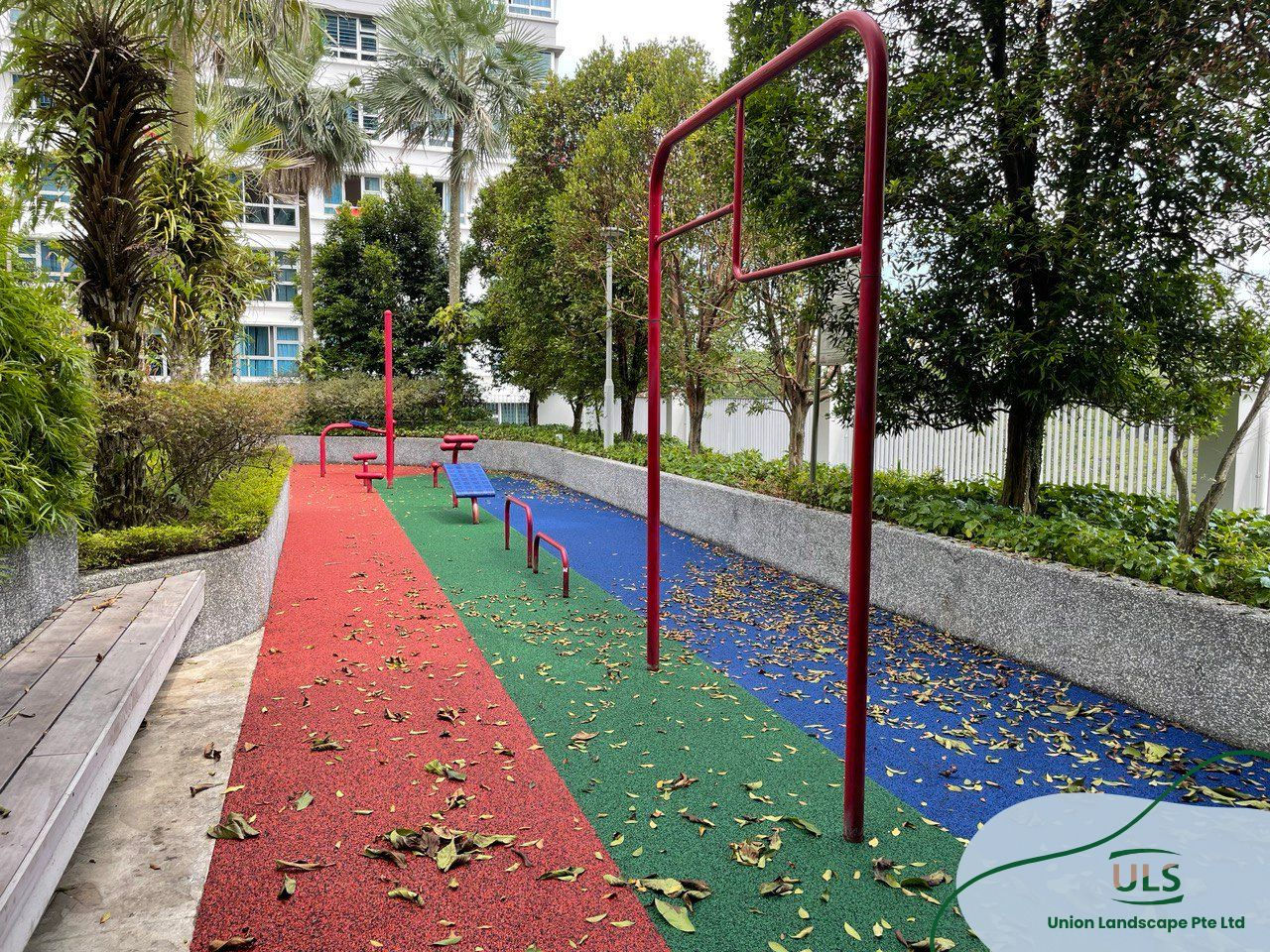
EPDM (wet-pour with an EPDM top layer) is the go-to for most Singapore playgrounds: seamless, colourful, custom patterns, good UV resistance, and it drains well in the monsoon. It costs more per square metre but ages best in our climate — it's what ULS installed across 13 play areas for a town council at Commonwealth.
Poured-in-place with an SBR-only top is the budget seamless option: same seamless, drains-well benefits, but the black SBR wearing course is less UV-stable and less vibrant, so it's better for shaded or covered areas.
Interlocking rubber tiles are the fastest and cheapest to install and the easiest to spot-repair (lift one tile, swap it), but the seams can lift, harbour dirt and fail over time in wet conditions — best for small, low-fall-height or temporary sites.
Whatever you pick, the surface must be rated to your equipment's free height of fall under SS 457 and impact-attenuation-tested to SS 495 (Critical Fall Height, based on HIC ≤ 1000 / gmax ≤ 200). Thickness follows fall height — taller equipment needs a thicker surface.
Quick rule: high-traffic, sun-exposed, want colour and longevity → EPDM; tight budget and shaded → poured-in-place SBR; small or fast-turnaround site → tiles.
By the Union Landscape team · Reviewed against SS 457:2017 and SS 495:2022 · Published 3 July 2026 · 12 min read
You already know your playground needs safety surfacing — that part isn't up for debate under Singapore's standards. The real decision is which surface: the seamless coloured rubber you see in most new HDB and condo playgrounds (EPDM), the plain black seamless rubber that costs less (poured-in-place SBR), or the interlocking mats you can lay in an afternoon (rubber tiles).
Get this choice right and you have a surface that survives a decade of sun and monsoon, passes inspection, and looks good. Get it wrong and you're re-doing debonded, chalky, or lifting flooring inside a few years — which is exactly the situation many town councils and MCSTs call us in to fix.
This guide is written the way we'd actually advise a client on site: as a decision matrix, not a sales pitch. We'll compare the three surfaces honestly — including where the cheaper options are the right answer — and show you how each maps to the parts of SS 457 and SS 495 that actually govern what you're allowed to install.
The one-line version
If you want the short answer: for most permanent, sun-exposed Singapore playgrounds, EPDM wet-pour is worth the premium — it's the most UV-stable, most colourful and most monsoon-friendly option, and it repairs seamlessly. Choose poured-in-place SBR if the area is shaded and budget is tight, and rubber tiles only for small, low, or temporary installations where fast install and cheap spot-repairs matter more than longevity.
The rest of this article is the "why," so you can defend the specification to your committee, town council, or ECDA licensing officer.
What are the three types of playground flooring, exactly?
People use these terms loosely, so let's define them precisely — because the differences drive everything downstream.
1. EPDM rubber flooring (wet-pour, coloured top layer)
EPDM stands for ethylene propylene diene monomer — a synthetic rubber granule that comes pre-coloured and is engineered to resist UV and weathering. In a playground context, "EPDM flooring" almost always means a two-layer wet-pour system: a thicker shock-absorbing base of black SBR (styrene-butadiene rubber, usually recycled) topped with a thinner wearing course of coloured EPDM granules, both bound on site with polyurethane and trowelled into one seamless surface.
That top EPDM layer is what gives you the vibrant colours, custom patterns, hopscotch grids, logos and inlays — and, crucially, the colour-fastness to hold up under the Singapore sun.
2. Poured-in-place (wet pour / wetpour / cast-in-situ), SBR top
Confusingly, "poured-in-place" describes the installation method — pouring and trowelling rubber granules mixed with binder on site — which EPDM systems also use. When people say "poured-in-place" as a cheaper alternative to EPDM, they usually mean a system where the top wearing layer is also SBR (black or a limited range of coated colours) rather than premium EPDM.
You get the same seamless, drains-well body — but a less UV-stable, less vibrant top. It's the budget seamless option.
3. Interlocking rubber tiles (rubber mats / rubber pavers)
Rubber tiles are pre-manufactured in a factory (typically 500 × 500 mm), cured, then shipped and laid on a prepared base — either loose-laid, interlocked with connector pins, or glued down. Because they're modular, you can install fast and, when one is damaged, lift and replace a single tile rather than cutting into a poured surface.
The trade-off is seams. Every joint is a potential entry point for water, dirt and lifting — and in a wet tropical climate, seams are where tile systems tend to fail first.
The plain-English version: EPDM and poured-in-place are both seamless liquid rubber cured on site — EPDM just has a better-quality coloured top. Rubber tiles are solid pre-made squares you lay down. Seamless = fewer failure points but pricier and slower; tiles = faster and cheaper but more seams to fail.
EPDM vs poured-in-place vs rubber tiles: the comparison table
Here's the head-to-head on the factors that actually decide a Singapore specification. Cost figures are indicative ranges for supply-and-install and vary with site access, base condition, thickness (fall height), design complexity and quantity — always get a site-specific quote.
Factor | EPDM (wet-pour, coloured top) | Poured-in-Place (SBR top) | Interlocking Rubber Tiles |
|---|---|---|---|
Construction | Seamless; SBR base + coloured EPDM wearing course, cast on site | Seamless; SBR base + SBR wearing course, cast on site | Pre-made 500×500 mm tiles, interlocked/glued on a base |
Indicative cost (supply + install) | Highest — request a site-specific quote | Mid — typically lower than EPDM; request a quote | Lowest for basic grades; premium safety tiles narrow the gap |
Colour & design | Excellent — full colour range, custom patterns, inlays, logos | Limited — mostly black or muted; less vibrant | Moderate — fixed factory colours; patterns via tile layout |
UV / weather resistance | Best — EPDM granules formulated to resist UV chalking & fading | Fair — black SBR is more prone to fading/chalking when sun-exposed | Good for the tile body, but seams degrade; colour depends on grade |
Monsoon drainage | Very good — porous, water drains through; dries fast | Very good — same porous seamless body | Fair — water pools/ingresses at seams; base drainage matters more |
Seams & trip risk | None — fully seamless | None — fully seamless | Many — seams can lift, curl or gap and become trip hazards |
Repairability | Patch-repairable, but colour/texture matching a patch is skilled work | Patch-repairable; black matches easily | Easiest — lift & swap a single tile; but matching aged colour is hard |
Typical lifespan (Singapore climate) | Longest of the three when correctly installed & maintained | Shorter top-layer life if sun-exposed | Shortest where seams/water take their toll; longer if sheltered |
Install speed / disruption | Slower — cure time; weather-dependent pour | Slower — same wet-pour cure constraints | Fastest — can walk on sooner; less weather-sensitive |
Best fit | Permanent, high-traffic, sun-exposed sites wanting colour & longevity | Shaded/covered areas on a tighter budget | Small, low-fall, temporary, or phased-install sites |
Don't let the per-square-metre price be your only lens. The cheapest surface to install is often the most expensive to own once you count re-levelling lifted tiles, patching chalked SBR, or a full early re-do. Ask every contractor to quote the 10-year picture, not just day one.
Which one survives the Singapore monsoon and sun without chalking?
This is where a lot of overseas manufacturer advice falls apart — most of it is written for temperate climates. In Singapore you're dealing with two brutal, simultaneous stressors: intense UV year-round and heavy, frequent rain.
UV and chalking usually come down to the top layer's grade. A low-grade or SBR top that isn't formulated for prolonged sun oxidises, fades and "chalks" over time — you can literally rub a powdery residue off with your hand. Genuine, quality EPDM granules are engineered to resist exactly this, which is why they hold their colour far longer in exposed conditions. If your playground bakes in full sun all day, this single factor often justifies EPDM over an SBR top.
Drainage is where both wet-pour systems earn their keep. Both seamless systems (EPDM and poured-in-place) are porous — water passes through the rubber matrix and drains away through the base below, so puddles clear fast and the surface is usable again quickly after a downpour. This is a real advantage in our climate. Tiles are more dependent on their base and joints; water tends to sit at seams and work its way underneath, which over years contributes to lifting and hidden degradation.
The base underneath is the part nobody sees, and it's often where systems actually fail. None of this works without proper sub-base preparation and drainage falls. We've been called to sites where the surface was fine but the base was never built to shed water, so the whole system failed early. A good installer spends as much attention below the rubber as on top of it.
A quick self-test for "will it survive?": Is the play area (a) in full sun most of the day, and (b) prone to standing water after rain? If yes to both, you want a seamless, UV-stable EPDM system on a properly drained base — this is the combination most likely to still look good in year eight.
Repairs and seams: what happens when it gets damaged?
Every playground surface gets damaged eventually — vandalism, tree-root heave, equipment removal, or simple wear at high-traffic pinch points like slide exits and swing under-zones. How each surface handles repair matters a lot over its life.
Tiles have the edge on ease of repair: lift the damaged tile, drop in a new one. But there's a catch — a brand-new tile rarely matches the faded colour of tiles that have been out in the sun for years, so repairs can look patchy. And if the reason for damage is seam lifting, you're often chasing a spreading problem.
SBR poured-in-place patches straightforwardly, because black-on-black hides the join well.
EPDM is fully repairable too — a skilled installer cuts out the damaged section and re-pours — but matching a patch into an existing coloured design is genuinely skilled work. The colour, granule size and texture all have to blend. This is a case for using an experienced flooring installer, not a general contractor, so a repair doesn't leave an obvious scar in your nice design.
This repairability difference is exactly why who installs it matters as much as what you install. If you're weighing contractors, our buyer's checklist for choosing a playground contractor in Singapore walks through the questions that separate a surface that's still sound in ten years from one that isn't.
Planning a project?
If you're staring at a tender or a committee paper and not sure which surface to specify, we can walk your site and tell you straight — including when the cheaper option is genuinely the right call. [Get a free site assessment and quote](https://www.ulssg.com/services), or talk to our team directly on +65 6748 8719.
How each surface maps to SS 457, SS 495 and critical fall height
Here's the part that's non-negotiable, and where a lot of buyers get caught out: your surface choice is constrained by your equipment, not just your budget or taste.
Two Singapore Standards govern this:
SS 457:2017 — Specification for playground equipment for public use. This governs the equipment itself, including its free height of fall (the maximum height a child can fall from) and the size of the impact area / safety zone that must be protected with impact-attenuating surfacing. It aligns with the European EN 1176 family.
SS 495:2022 — Impact attenuation of playground surfacing. This governs the surface. It defines how surfacing is tested and assigns each system a Critical Fall Height (CFH) — the maximum fall height at which that surface, at that thickness, keeps head-injury risk within acceptable limits. It aligns with EN 1177.
The key number: under SS 495 / EN 1177 testing, a surface's Critical Fall Height is the lowest drop height that produces a Head Injury Criterion (HIC) value of 1000, or a gmax of 200 — whichever comes first. In plain terms: the surface has to soften a fall enough that the measured head-impact severity stays below those thresholds. The bigger the drop your equipment allows, the more cushioning (and usually the more thickness) you need.
What this means for your specification:
Find your equipment's free height of fall (from the SS 457 documentation for that equipment). Under the standard the maximum is 3 metres — equipment shouldn't allow a free fall greater than that. Always confirm the exact figure against the current published standard or your equipment supplier's documentation, since permitted values can vary by equipment type.
Specify a surface with a Critical Fall Height at or above that number. A surface rated to a CFH of 1.5 m is not compliant under a structure with a 2.5 m fall height — regardless of whether it's EPDM, SBR or tiles.
Thickness follows fall height. For all three surface types, achieving a higher CFH generally means installing a thicker shock-absorbing layer. This is why a surface under a tall multi-play tower costs more per square metre than the same surface under a toddler spring-rocker — you're literally installing more rubber.
The compliance one-liner: SS 457 tells you how far a child can fall; SS 495 tells you how well the surface must catch them. Your job — and your contractor's — is to make the surface's Critical Fall Height ≥ the equipment's free height of fall, then confirm it with test evidence.
Any of the three surfaces can, in principle, be built to hit a given Critical Fall Height — the difference is how much thickness (and cost) it takes, and whether you get documented test evidence for the installed system. Always ask your installer for the impact-attenuation basis for the thickness they're proposing. For a deeper walkthrough of both standards and what facility managers are actually responsible for, see our explainer on SS 457 and SS 495 playground safety standards.
Match the surface to your site: quick decision scenarios
Rules of thumb are dangerous in isolation, but here's how the trade-offs usually land for common Singapore buyers.
You'll want EPDM if…
It's a permanent, high-traffic playground — condo, HDB estate, town-council common area, school.
The area is exposed to full sun and you don't want chalking or fading in a few years.
You want colour, custom patterns, branding or a wayfinding design integrated into the surface.
You're taking a whole-life-cost view and want the longest-lived option.
You'll lean toward poured-in-place SBR if…
The play area is covered, shaded or indoors, so UV isn't the main enemy.
Budget is the hard constraint and you can accept a black/muted, seamless surface.
You still want the seamless, no-trip, good-drainage benefits of wet-pour without the EPDM premium.
You'll consider rubber tiles if…
It's a small, low-fall-height area — a toddler corner, a fitness-corner base, a rooftop deck.
You need a fast install with minimal cure time and disruption.
The site is temporary or phased, or you specifically want easy tile-by-tile replacement.
The area is sheltered, reducing the seam-and-water failure risk that hurts tiles outdoors.
Special cases worth flagging:
Childcare and preschool (ECDA-licensed): outdoor play areas have their own layout, safety and equipment expectations on top of the surfacing standards. Get the surfacing and the play-area design right together — our preschool outdoor play area requirements guide covers what ECDA operators need.
Renewal / replacement projects: if you're ripping out failed flooring, the base often needs remediation too — don't just re-surface over a bad base and inherit the same failure. (This was the crux of our Commonwealth renewal — see below.)
Ongoing duty of care: whichever surface you install, it must be inspected and maintained on a schedule — our guide on how often playground equipment should be inspected in Singapore covers the cadence owners are expected to keep.
Proof point: our EPDM renewal at Commonwealth
Theory is one thing; here's what this looks like on a real Singapore town-council job.
At Commonwealth, we carried out an EPDM flooring renewal across 13 existing play areas for the town council. The existing surface had debonded — a classic end-of-life failure where the rubber separates from its base — so a simple resurface wasn't going to hold. Our process was: dismantle and remove the old debonded EPDM, install a fresh SBR shock-absorbing base, sketch out custom designs, and apply vibrant, UV-resistant coloured EPDM granules in engaging patterns.
The reason it's a good illustration of this whole article: the client didn't just need "rubber flooring," they needed the right system rebuilt from the base up — which is why the seamless, UV-stable EPDM route made sense for a permanent, sun-exposed, high-use estate setting.


You can read the full write-up on the Union Landscape EPDM flooring renewal project at Commonwealth.
Ready to specify with confidence?
We supply and install all three surface types — EPDM, poured-in-place and rubber tiles — plus sports and multi-purpose flooring, so we're not trying to sell you one product. We'll recommend what actually fits your site, fall heights and budget. [Request a free site assessment and quote](https://www.ulssg.com/services), email sales@ulssg.com, or call +65 6748 8719 to talk it through.
The bottom line
There's no single "best" playground flooring in Singapore — there's the best surface for your site. Anchor the decision on four things, in this order: (1) the fall height of your equipment under SS 457 and the Critical Fall Height the surface must hit under SS 495; (2) sun exposure — full sun pushes you toward UV-stable EPDM; (3) whole-life cost, not just install price; and (4) who installs it, because on a seamless system the workmanship is the product.
Nail those, and you get a surface that passes inspection, survives the monsoon, and still looks good long after the ribbon-cutting.
Frequently Asked Questions
What is the difference between EPDM and poured-in-place rubber flooring?
They overlap. Both are seamless "wet-pour" systems cured on site, and both typically use a black SBR shock-absorbing base. The difference is the top wearing layer: an EPDM system uses coloured EPDM granules that are UV-resistant and come in a wide colour range, giving you vibrant, custom, long-lasting designs; a budget poured-in-place system uses an SBR top (usually black or muted) that costs less but fades and chalks faster in the sun. So "EPDM" is really a higher-grade, more colour-fast version of poured-in-place.
How much does playground rubber flooring cost in Singapore?
Pricing is quoted per square metre for supply and install, and it varies with the surface type, the thickness required (driven by your equipment's fall height), design complexity, site access and quantity. As a general ranking: interlocking rubber tiles are usually cheapest per m² for basic grades, poured-in-place SBR sits in the middle, and coloured EPDM is the most expensive but longest-lived. Because thickness scales with the required Critical Fall Height, a surface under a tall play tower costs more than the same surface under a toddler rocker. Always get a site-specific quote rather than relying on a headline rate — and ask for the 10-year cost of ownership, not just the install price.
Which playground surface is best for Singapore's weather?
For sun-exposed outdoor sites, a seamless EPDM wet-pour system generally performs best. EPDM granules are formulated to resist UV so they don't chalk or fade like a cheaper SBR top layer, and the porous seamless body drains rain quickly instead of pooling. Rubber tiles are more vulnerable outdoors because water sits at the seams and works underneath over time. If an area is shaded or covered, poured-in-place SBR or tiles become more viable since UV is less of a factor.
What thickness of rubber surfacing do I need for my playground?
Thickness is dictated by your equipment's free height of fall, not chosen arbitrarily. Under SS 457 the maximum free height of fall is 3 metres, and under SS 495 the surface must have a Critical Fall Height at or above that fall height. The higher the potential fall, the thicker the shock-absorbing layer needs to be to keep the head-injury measure within limits (HIC ≤ 1000 / gmax ≤ 200). Your installer should specify thickness against the impact-attenuation requirement and be able to show the basis for it.
Do playground surfaces in Singapore have to meet SS 495?
Yes — impact-attenuating playground surfacing in Singapore is assessed against SS 495:2022, which specifies how surfacing is tested for impact attenuation and assigns a Critical Fall Height. It works hand-in-hand with SS 457:2017 for the equipment. In practice, that means your surface must be tested/rated so its Critical Fall Height meets or exceeds the fall height of the equipment above it. Facility managers, MCSTs, town councils and childcare operators should ask contractors for the impact-attenuation basis of the installed system as part of due diligence and inspection.
Can you repair playground rubber flooring, or does the whole area need replacing?
In most cases, yes — spot repair is possible on all three types. Rubber tiles are easiest: lift and replace a single tile, though a new tile may not match faded neighbours. Poured-in-place SBR patches easily because black-on-black hides the join. EPDM is fully repairable too, but blending a patch into an existing coloured design is skilled work, so it's worth using an experienced flooring installer. If the flooring has debonded from its base across a wide area (an end-of-life failure), a proper renewal that rebuilds the base is usually better value than repeated patching.


Comments