
Top 5 Outdoor Playground Equipment Ideas for Singaporean Schools
Updated: Jul 4
The short version
Match equipment to the outcome, not the catalogue photo. For schools the useful question is what each item does for active play, PE, cooperative learning or inclusion — then whether it survives daily class-sized use in our climate.
Five ideas that earn their footprint: multi-play climbing structures, outdoor fitness circuits, cooperative/inclusive play, nature and loose-parts zones, and shaded structures — each carries a different footprint and supervision load.
The surfacing decides the budget as much as the equipment. Every raised item has a Critical Fall Height that must be matched by SS 495-compliant surfacing under SS 457 — a taller structure quietly enlarges the impact area you have to pay for.
Shade is not optional in Singapore. Un-shaded steel and dark rubber get too hot to use by mid-morning; plan shade sails or sheltered structures from day one, not as an afterthought.
Tell us the yard's dimensions, age group and budget and we'll map equipment, footprint and surfacing into one buildable plan — sales@ulssg.com or +65 6748 8719.
By the Union Landscape team · Updated 3 July 2026 · 11 min read
Every school outdoor space we're asked to quote starts the same way: someone has a rough budget, a patch of yard, and a catalogue full of colourful structures that all look great in the photo. The hard part isn't choosing something that looks good. It's choosing equipment that suits this yard, these ages, the PE and learning outcomes the school actually cares about — and that survives a decade of class-sized use in Singapore's sun and rain without becoming a maintenance headache.
This guide walks through five categories of outdoor playground equipment that consistently earn their place in a school ground, what each one does for learning and PE, roughly how much footprint it eats, and the durability, supervision and safety-surfacing realities that decide whether it's a good buy. It's written from the contractor's side of the table — the things we wish more specs accounted for before the tender goes out.
What should a school actually be buying — outcomes, not just equipment
The most useful shift a facilities or ops lead can make is to stop shopping by product name and start shopping by outcome. A "climbing frame" is a category; "somewhere 60 lower-primary pupils can burn energy safely in a 20-minute recess, watched by two teachers" is a brief. The second version tells you the deck heights, the supervision sightlines, the throughput, and the surfacing you'll need.
For schools, most equipment maps to one of four outcomes:
Active play and gross-motor development — climbing, sliding, balancing, swinging. The core of recess energy-burn and physical confidence.
PE and fitness — structured strength, agility and circuit work you can build a lesson around.
Cooperative and inclusive play — equipment that gets children collaborating and includes those with mobility or sensory differences rather than sidelining them.
Curriculum and nature-based learning — loose parts, sand-and-water, planting and sensory zones that spill into science, art and unstructured discovery.
The one-line version: buy the outcome, then let the outcome dictate the equipment, the footprint and the surfacing — in that order. The moment you reverse it, you end up with a beautiful structure that's the wrong height for your pupils and a fall zone that doesn't fit your yard.
Two constraints sit underneath all of these in Singapore, and they're the ones budgets most often underestimate:
Surfacing and fall height. Every raised element has a Critical Fall Height (CFH) — the maximum height a child could fall from — and under SS 457 that height must be matched by impact-attenuating surfacing tested to SS 495. A taller structure doesn't just cost more as equipment; it quietly enlarges and thickens the surfacing you have to pay for underneath and around it. We go deep on this in our explainer on Singapore's SS 457 and SS 495 playground safety standards, and it's worth reading before you finalise any equipment list.
Heat and weather. Un-shaded metal and dark rubber get too hot to touch by mid-morning here. Shade isn't a nice-to-have you add later — it's a design input from day one, and we've given it its own section below.
Idea 1 — Multi-play climbing structures (the active-play workhorse)
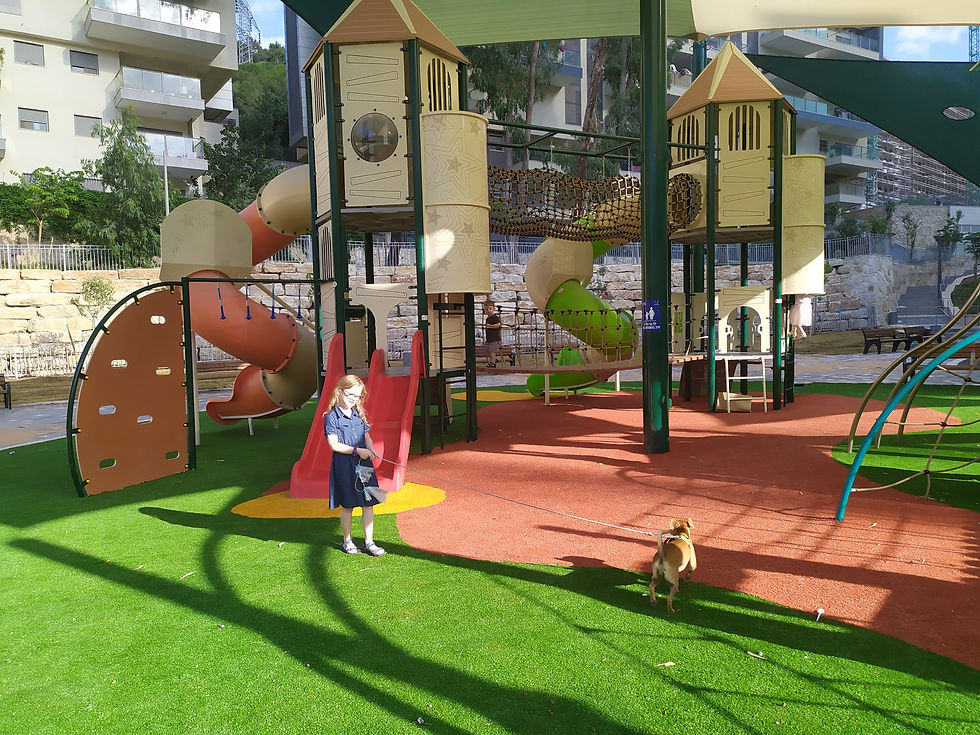
If a school buys one thing, it's usually a multi-play unit: a combined structure with decks, a slide or two, climbers, and often a bridge or clatter link. Done well, it's the highest-value item in the yard because it delivers a lot of different movement — climbing, descending, balancing, crossing — in one connected footprint that a couple of staff can supervise from one vantage point.
What it does for learning: gross-motor development, spatial reasoning, risk assessment (children learning their own limits), and the plain social value of a shared focal point at recess.
Footprint reality: the structure itself might be 25–45 sqm, but the honest number is the impact zone — the clear, surfaced area around every fall edge, typically 1.5m minimum and more for higher decks. Budget for the equipment footprint plus that safety zone, not the equipment alone. A compact unit can easily need 60–100 sqm of clear, surfaced ground.
Durability and supervision: specify hot-dip galvanised or powder-coated steel, HDPE panels rather than painted ply, and stainless or marine-grade fixings if you're anywhere near the coast. Keep the tallest decks in clear sightline of where staff stand. For mixed-age schools, a single very tall tower is often a mistake — it's too much for the youngest and quickly boring for the oldest.
A quick self-test: stand where a supervising teacher will actually stand at recess. Can they see the top of every climber and the bottom of every slide without moving? If not, the layout — not the equipment — needs rethinking.
Idea 2 — Outdoor fitness circuits (equipment PE can build a lesson around)
Outdoor fitness equipment — pull-up and dip stations, step platforms, balance beams, monkey bars, agility elements — is one of the most under-used ideas in Singapore school grounds, and one of the best value for older primary and secondary students. Unlike a play structure that children use however they like, a fitness circuit can be programmed: a PE teacher can run stations, time laps, and track progression across a term.
What it does for learning: structured strength, coordination, agility and cardiovascular work that plugs straight into the PE syllabus, plus a space that stays useful before and after school hours.
Footprint reality: circuits are flexible — you can string a linear route along the edge of a field or cluster stations in a compact zone. Individual stations have smaller fall zones than a big tower, but bars and elevated elements still carry a CFH, so surfacing still applies under and around them.
Durability and supervision: these get gripped, hung on and jumped off constantly, so fixings and coatings are everything. Space stations so a class rotating through doesn't collide, and keep the run visible end-to-end. A fitness zone pairs naturally with an active-play structure — the older students gravitate to one, the younger to the other, which spreads supervision load.
You'll want a fitness circuit if: you teach upper primary or secondary PE outdoors, you want equipment that earns its keep in lesson time (not just recess), or you need something that suits older students who've outgrown the play structure.
Planning a project?
If you're a school ops lead or facilities manager scoping outdoor equipment, a short site conversation saves a lot of spec churn later. Tell us the yard dimensions, the age groups and the budget band, and we'll come back with an equipment-and-surfacing plan that actually fits. Email sales@ulssg.com, call +65 6748 8719, or send the details through the Union Landscape contact form.
Idea 3 — Cooperative and inclusive play (one purchase, wider reach)
Cooperative and inclusive equipment is where schools get disproportionate value, because a single well-chosen item serves more children and more outcomes at once. Group swings (basket or nest swings), see-saws and spinners that need two or more children, ground-level interactive panels, wide ramps and transfer points, and sensory elements all fall here.
What it does for learning: turn-taking, negotiation, teamwork and empathy — the social-emotional outcomes schools increasingly want the yard to support. Inclusive design means a child using a wheelchair, or one with a sensory sensitivity, can play alongside peers rather than watch from the side.
Footprint reality: varies widely. Ground-level panels have almost no fall zone and slot into tight corners; a nest swing needs a generous clearance arc front and back because swinging equipment has a larger impact area than static play. Ramps for accessibility add length but pay back in reach.
Durability and supervision: moving parts — swing bearings, spinner mechanisms — are the maintenance items to watch, so factor them into your inspection routine. Inclusive elements are often the lowest-supervision items in the yard, which is a quiet bonus for stretched staff.
The one-line version on inclusion: an inclusive yard isn't a separate "special" area bolted on the side — it's mainstream equipment chosen so more children can use the same space at the same time.
Idea 4 — Nature play and loose parts (the curriculum bridge)
Not everything valuable in a school yard is fixed steel. Nature-based and loose-parts play — sand-and-water zones, planting beds, log walks, boulders, movable blocks and building materials — bridges the playground and the classroom in a way manufactured equipment can't. It's open-ended: the same sand table supports early-years maths, science observation, art and pure imaginative play.
What it does for learning: creativity, problem-solving, science and environmental awareness, fine-motor skills, and the kind of unstructured discovery that structured equipment doesn't prompt. This category is especially strong for preschools and lower primary.
Footprint reality: flexible and often cheaper per square metre than manufactured structures, because much of it sits at ground level with minimal fall height. Sand and water zones need drainage and a maintenance plan; loose parts need somewhere to be stored and tidied.
Durability and supervision: the trade-off is that nature play is higher-touch — sand gets scattered, water needs draining, plants need tending, loose parts need collecting. It also usually needs closer supervision than a fixed structure. That's a fair trade for the learning value, but it's a real staffing input, so plan for it rather than discovering it after installation.
You'll want a nature/loose-parts zone if: you run an early-years or lower-primary programme, you want the yard to feed directly into curriculum, or you have a shaded pocket of ground that doesn't suit a large fixed structure.
Idea 5 — Shaded and sheltered structures (a Singapore essential, not an add-on)
We've put shade last so it lands, because it's the thing most specs treat as optional and shouldn't. In Singapore's climate, un-shaded equipment is unusable for large parts of the day: dark rubber surfacing and steel decks absorb heat and become genuinely too hot to use by late morning, and prolonged UV shortens the life of both equipment and surfacing.
What it does for learning: simply, it keeps the yard usable. A shaded playground is available across more of the school day, in more of the year, which multiplies the value of everything you installed underneath it.
Footprint reality: shade sails, tensile canopies or sheltered structures cover the equipment they protect — so shade planning is really equipment-layout planning. Cluster the items that most need protecting (metal slides, the main structure, seating) under the shaded area.
Durability and supervision: good shade also protects your investment — cooler surfaces and less UV mean equipment and surfacing last longer, so shade partly pays for itself in deferred replacement. Specify UV-stable, properly tensioned fabric and engineered anchors; a sail that flaps or sags is a failure waiting to happen.
A quick self-test on heat: walk the intended yard at 11am on a clear day and put your hand flat on where the surfacing will go. If you wouldn't kneel on it in shorts, neither will a child — that spot needs shade before it needs equipment.
Mapping equipment to outcome, footprint and supervision
Use this as a first-pass planning table. Footprints are indicative and always depend on the specific product and, more importantly, the fall zone around it — the surfacing note is the one that most affects budget.
Equipment type | Primary learning / PE outcome | Best-fit ages | Indicative footprint (incl. fall zone) | Supervision load | Surfacing note |
|---|---|---|---|---|---|
Multi-play climbing structure | Active play, gross-motor, spatial reasoning | Preschool–upper primary | Medium–large (60–100+ sqm) | Medium — needs clear sightlines | Higher CFH → thicker/wider SS 495 surfacing |
Outdoor fitness circuit | Strength, agility, programmable PE | Upper primary–secondary | Flexible (linear or clustered) | Low–medium | Surfacing under bars/elevated stations |
Cooperative / inclusive play | Teamwork, turn-taking, inclusion | All ages | Small–medium (panels tiny; swings need arc) | Low–medium | Swings need larger impact zone; panels minimal |
Nature play / loose parts | Creativity, science, fine-motor | Preschool–lower primary | Flexible, often ground-level | Higher — hands-on, tidying | Mostly low fall height; drainage for sand/water |
Shaded / sheltered structure | Keeps whole yard usable | All ages | Covers the equipment beneath | N/A (protects other items) | Reduces heat and UV on surfacing below |
How to sequence the decision
A workable order for a school project looks like this:
Define the outcomes and age split — what should recess and PE achieve, and for whom.
Zone the yard — a lower-challenge area and a higher-challenge or fitness area, with supervision sightlines drawn before equipment is chosen.
Choose equipment per zone — from the five categories above, sized to the ages.
Size the surfacing to the tallest equipment's CFH — never the reverse.
Layer in shade over the items and seating that most need it.
Plan the inspection and maintenance routine — because compliance is ongoing, not a one-time handover.
Choosing the party who'll actually stand behind all of that matters as much as the equipment. Our guide on how to choose a playground contractor in Singapore covers the documentation and test-report questions worth asking any bidder before you sign.
The realities that separate a good spec from a regretted one
A few things we see go wrong, offered plainly so you can design around them.
Sizing to equipment, not fall zones. The single most common footprint error. The equipment fits; the safety zone doesn't. Always plan the impact area, then check the equipment fits inside the space you have left.
Treating surfacing as a finishing item. Surfacing isn't the thing you specify last with whatever budget remains — it's a safety system tied to the Critical Fall Height of your equipment, and under-specifying it is where compliance quietly fails. Across our Singapore installations, the projects that go smoothly are the ones where the surfacing was sized alongside the equipment, not after it.
Under-specifying materials for the climate. Budget coatings chalk and rust, un-treated timber warps, and cheap fixings corrode — especially on exposed or coastal sites. Paying up front for galvanising, HDPE and marine-grade fixings is cheaper than a mid-life refurbishment.
Forgetting the maintenance and inspection load. Nature play needs tending, moving parts wear, surfacing depth needs checking. A yard is a thing you operate, not just a thing you install — plan the routine from day one.
The one-line version: the equipment is the easy part. The footprint arithmetic, the surfacing engineering, the material grades and the maintenance plan are what decide whether the yard is still safe, compliant and loved in five years.
Ready to plan your school playground?
If you're specifying a new outdoor play area, refreshing a tired one, or trying to work out what will actually fit your yard and budget, a site assessment removes the guesswork. We'll map equipment, footprint, fall-height surfacing and shade into one buildable plan — and phase the works around your term calendar so classes aren't disrupted.
Browse our outdoor playground equipment range to see the categories above in real products, then get in touch: email sales@ulssg.com, call +65 6748 8719, or send your yard dimensions and age groups through the Union Landscape contact form and we'll come back with a plan.
Frequently Asked Questions
How much outdoor space does a school playground actually need?
There's no single number — it depends on the equipment mix and, crucially, the fall zones. A common mistake is sizing the yard to the equipment footprint and forgetting the impact area around it. Under SS 457 every piece with a free-height of fall needs a clear, correctly surfaced zone around it (typically extending at least 1.5m, more for higher or swinging equipment). A compact multi-play unit might occupy 25–40 sqm of structure but need 60–100 sqm once the safety zone is added. Send us your yard dimensions and target age group and we'll map a realistic layout before you commit to any equipment list.
Does outdoor playground equipment for a Singapore school have to meet SS 457?
For equipment intended for public use — which includes school playgrounds — yes, SS 457:2017 is the applicable Singapore Standard for the equipment, and SS 495:2022 governs the impact-attenuating surfacing underneath. In practice, MOE and many preschool procurements will expect equipment certified to SS 457 or the equivalent EN 1176, plus a project-specific surfacing test showing the Critical Fall Height is met. The document trail matters as much as the product: ask for a handover package with the fall-height and surfacing test report for your specific site, not a generic brochure certificate.
What playground surfacing works best under school equipment?
It depends on the fall height and how the space is used. Poured-in-place EPDM rubber is popular for schools because it gives a seamless, wheelchair-friendly surface and can be engineered to a specific Critical Fall Height, but it costs more per square metre. Rubber tiles are quicker to install and repair in sections. Loose fill like sand or engineered wood fibre is cheaper upfront but needs topping-up and raking to keep its depth (and therefore its safety rating). The right answer is whichever meets the CFH of your tallest equipment across the whole impact zone — we size the surfacing to the equipment, never the other way round.
How do we choose equipment that suits mixed ages in one school yard?
Zone it. Rather than one structure that's too tall for the little ones and too tame for the older students, split the yard into a lower-challenge zone (deck heights and reach designed for younger pupils) and a higher-challenge or fitness zone for older ones, with clear sightlines so one or two supervising staff can watch both. Cooperative and inclusive elements — ground-level panels, wide ramps, group swings — work across ages and reduce the number of separate items you need to buy and maintain.
How long does school outdoor playground equipment last in Singapore's climate?
Well-specified commercial equipment lasts many years, but the climate is the real test: UV, heavy rain and salt-laden air near the coast are hard on materials. Hot-dip galvanised or powder-coated steel, HDPE panels and marine-grade fixings hold up far better than budget alternatives. The failure points we see most are un-treated timber, thin coatings that chalk and rust, and surfacing that was never topped up. Shade extends the life of both equipment and surfacing by keeping surface temperatures and UV exposure down. Budget for routine inspection from the start — catching a worn fixing early is far cheaper than a mid-life refurbishment.
Can you install play equipment during school term without disrupting classes?
Usually, yes — most of our school and institutional work is phased around the site's operating hours. Groundworks, equipment installation and surfacing can be sequenced so that one zone is hoarded off and worked on while the rest of the yard stays usable, and the noisier or wetter stages (poured surfacing needs curing time) can be scheduled for holidays or weekends. The key is planning the phasing and hoarding into the project from the quotation stage. Tell us your term calendar and we'll build the programme around it.


Comments